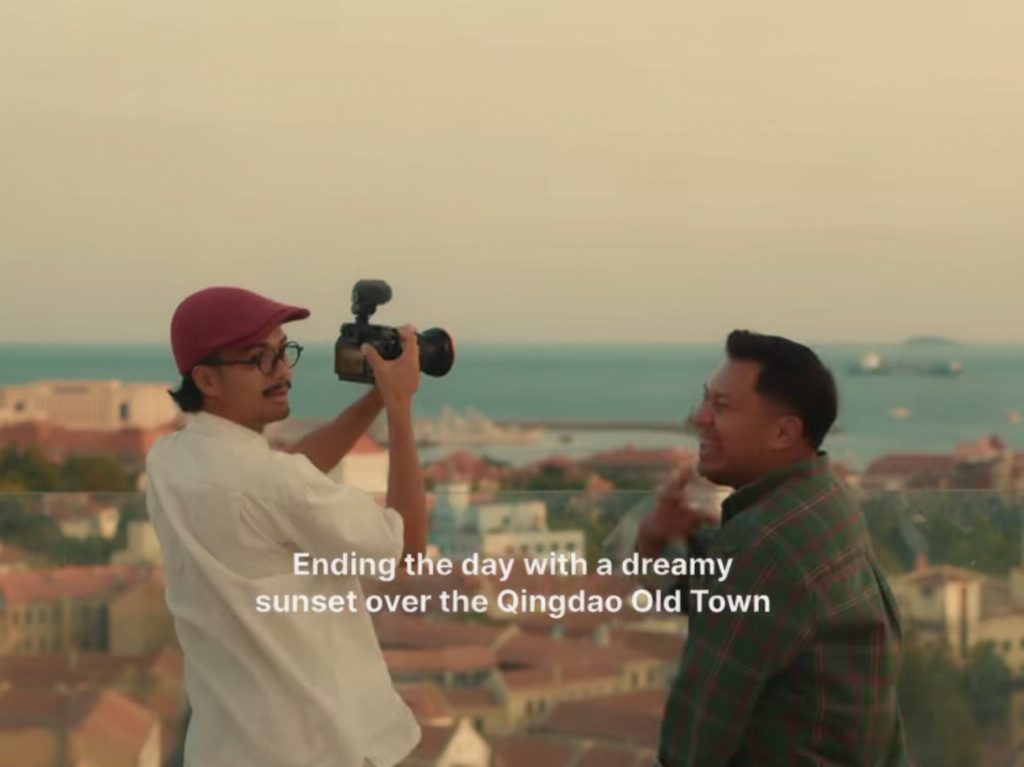
Before coming to Shandong, I thought that there were only modern buildings here.
Pojiegraphy is a travel content creator from Malaysia. In September this year, he was invited to Shandong to gather inspiration and create content. In front of the camera, he spoke plainly: "Before coming here and after coming here, my experience was completely different." Below is his account.
Q| Before coming to Shandong, what was your impression of this place?
A: Before coming to Shandong, I thought that the area had only modern architecture. But once I actually arrived, my perception changed completely—everything I saw was different. I could see the local customs and ways of life, appreciate the beautiful culture, see the mountains, and even see the beaches. None of these things had occurred to me before I came here.
Qingdao is the star of his lens. At the beginning of the video, he says: "You won't believe it, but this city isn't actually in Europe. From Kuala Lumpur, it takes only about six hours by plane to reach this city in Shandong—a place where 'some parts look remarkably like Europe.'" German-style architecture is visible throughout the city: red tiles, green trees, and churches with pointed spires; every frame looks like a postcard.
But for him, Qingdao is far more than just architecture. "It's a city of one million people; when you come here, the fresh, delicious food is something you absolutely shouldn't miss." He also said that his favorite aspect was the scenery along the ramps: walking slowly uphill through the old town, passing the cafes along the way and at the street corners—all of these offered beautiful ways to conclude the day.
"So, put aside those cookie-cutter cities and add Shandong to your list." Facing the camera, he extended an invitation to the Malaysian audience.
Q| If you were to recommend a travel itinerary to a Malaysian tourist, how would you design it?
A: I would recommend the route I took this time: the "Qilu Cultural Route"—Qufu, Tai'an, and Jinan. The Confucius Temple study tour, the blessing ritual at Mount Tai, and a leisurely stroll through the Spring City are all connected into one cohesive itinerary, allowing you to experience the profound cultural heritage of China. If you'd like to add a coastal segment, simply include Qingdao afterward: Zhanqiao and the Beer Museum offer something for both children and adults; regarding dining, just let the restaurant know that you prefer halal cuisine. There are already direct flights between Kuala Lumpur, Penang, and Qingdao, making travel very convenient.
The flight from Kuala Lumpur to Qingdao takes six hours. Before boarding, you might imagine arriving in a modern city of steel and concrete; upon landing, however, you are greeted by red tiles, green trees, and the soaring spires of churches. Turn around, and you'll find mountains, the sea, and the Confucius Temple. This sense of dislocation—of having "gone to the wrong filming location"—is precisely the kind of delightful surprise that Malaysian tourists are most eager to share with their families. There are halal-friendly dining options, a cultural narrative that doesn't rush along a fast-paced timeline, and coastal areas where children and older visitors can each find their own place to explore. Shandong doesn't require much preparation from you: all you need to do is buy a ticket and come in person to experience for yourself that "this place is completely different from what I imagined."